Carmel Hassan Montero
Designing digital products since 2007. I've played many roles, titles given by the org, but what stayed constant was the same inner energy: an honest belief that technology can be useful, usable, and engaging for anyone.

After finishing my Computer Engineering degree, I spent my early career as a web developer. Working alongside designers taught me to care about the why behind every decision — and led me naturally into UX design.
Most designers come from visual design. I came from engineering, and for whatever reason that modeled my way of thinking about the design process: shipping a product is as important as keeping intact the intention behind building it.
- Email: carmel.hassan@gmail.com
- LinkedIn: /in/carmel-hassan-montero
Work
I design products for people doing complicated work.
Most of my career has been in B2B—finance teams making international payments, healthcare professionals managing patient data, developers troubleshooting distributed systems. These aren't casual users, but experts under pressure, often dealing with high stakes. A confused interface doesn't just annoy them—it costs time, money, and sometimes more.
I'm drawn to the messy problems. Multi-currency workflows where one mistake means someone doesn't get paid. Clinical interfaces where confusion could affect patient care. Observability tools where developers need answers in seconds during a production incident.
These problems don't have obvious solutions. That's what makes them interesting.
Experience
Screens get old, but learnings remain and have helped me to connect the dots.
A real-time query interaction model at ITRS became the basis for how I think about NRQL and Notebooks at New Relic, a decade later. An instrumentation library I built from scratch at ITRS became Ebury's measurement framework. A widget-based design pattern at CSC became a reusable pattern for later products.
-
New RelicSenior Product Designer2024 - PresentLead designer of New Relic Notebooks: created the design vision and specification a troubleshooting solution based on data-scientist notebook paradigm.Leading the design of an innovative troubleshooting solution that brings the data-scientist notebook paradigm to observability, enabling engineers to document, share, and collaborate on system analysis.
-
Monoceros LabsInteraction DesignerJul 2022 - Jul 2024Strategic designer of Fonos, an online TTS editor: Created the MVP and brand identity for this innovative product using Generative AI and voice tech. Also served as the conversational designer for the Lingokids Alexa Skill.Led product design for an innovative AI tool focused on creating and utilizing artificial voices. Worked as both Interaction Designer and Front-end Developer in a small startup team, defining the complete user experience from concept to implementation.
-
The Honest Make TankLead Product DesignerFeb 2021 - May 2022Strategic designer of Skate, a Chrome extension for email communication: Researched email's impact at work and designed a team chat UI to enhance understanding and actionability of email information.Main Product Designer in a team of 5. When the initial customer service assistant idea didn't validate, we pivoted based on new research. Designed a Chrome extension that transforms email into a collaborative team communication tool.
-
EburyUX LeadMar 2017 - Feb 2021Led a design team of five at Ebury Online, an international payment platform. Redesigned key workflows, boosting user interaction and satisfaction. Achieved a 30% increase in new users, 15% rise in conversions, and a 5-point improvement in NPS.Led a team of five designers working on people-facing products including website, communications, online platform, and backend system. Ebury Online enables clients to make international payments (spot and forward) for multiple currencies. Established design culture in an engineering-led fintech organization.
-
ITRSSenior UX SpecialistJan 2015 - Feb 2017Strategic designer of Valo, a real-time analytics visualization tool: Developed an innovative interaction model for querying data through direct manipulation of data visualizations.Created an innovative interaction paradigm that allowed users to query complex data by directly manipulating visualizations. This approach reduced the learning curve and made powerful analytics accessible to non-technical users monitoring system performance.
-
CSCUI Designer - Design LeadSep 2009 - Jan 2015Lead designer of Bluebird, a UI framework for healthcare solutions: Developed patient safety UI standards, created a design system and guidelines, and managed a team of six designers and four developers.Designed software in one of the most challenging and regulated sectors. Built patient safety UI standards and created a comprehensive design system. Navigated complex clinical procedures, heterogeneous needs, and strict legislation while managing a team of 10 people. Despite bureaucratic challenges, delivered solutions that improved clinical workflows.
-
Self-employedWeb DesignerSep 2008 - Sep 2009Built websites for clients like Greenpeace, Roca, and NOS ONG: Defined and implemented information architecture, concept design, and theming.
-
Trevenque GroupWeb DeveloperApr 2007 - Sep 2008Built websites for Club Kirico and Viajes Altair: Coded and themed complete sites using Drupal.
Approach
I don't believe there's one right way to design, and after all these years I've stopped pretending there is.
Early in my career, everyone was obsessed with adopting Scrum and Agile canonically — a process that, by principle, assumes anyone can do anything, ignoring that design is its own discipline. I see the same pattern now with AI: teams treat it as a fixed sequence — research, then ideate, then build, then test — because that's the canonical process everyone points to. But the moment you're fixed on a sequence, you realize not every step makes sense for your team or your project. Sometimes research comes third. Sometimes you brainstorm first and check assumptions after. What matters isn't the order — it's understanding the value each activity actually gives you.
AI has changed what's possible here in a real way: it's fast enough now to build something interactive, close to the real experience, before ever opening a design tool — so I can test a hypothesis with users directly, and pull in research just-in-time as I design, instead of always front-loading it.
I'm a talk-first designer, not a sketch-first one — I like to build the big vision early: understand the goal, then talk to users and stakeholders in parallel, comparing how each of them sees the problem, so the details become straightforward once the strategy is clear. But I don't force that on the people I work with. I've led designers who think visually before they can even describe an idea in words — forcing them into a wireframe-first process would waste their real strength. Letting people use their own language is the better move, for them and for the work.
- Read my article: How I Work
Community
In 2015, I was working at a startup. Same patterns I'd seen at other companies: dismissive comments, exclusionary behavior, jokes that weren't really jokes. I was tired of wondering if it was just me.
So I tweeted. "Does anyone else feel this way?"
Turns out, a lot of people did. We met in Málaga that July. It was supposed to be one meeting. It became a community. Then an NGO.
Yes We Tech is now 1,500+ members. We organize conferences, provide grants and mentorship, advocate for inclusive education, and create spaces where women in tech don't have to pretend everything is fine. A few years in, I noticed something had shifted, and I deliberately stepped back to make room for new people and new voices. It was the right call — the community is in a genuinely good place now, shaped by people who aren't me, and I couldn't be prouder that it's outlasted my involvement.
In 2022, we co-organized WeyWeyWeb, an international UI conference in Málaga with 60% women and non-binary speakers and 500+ attendees — the only tech conference in Málaga, and likely in Spain, with that kind of representation. Organizing it has been a genuine gift to me as a designer: I got to choose the people I wanted to learn from, in my own hometown.
I taught UX at Lemoncode's master's program since 2015 — alongside Braulio, who directed it and made it one of the best professional relationships I've had. The program taught developers, not designers, what they actually needed to know about design — not the surface, but the root of the theory. Students would tell me, "I can't believe this is the origin of everything." When I stopped teaching it, because it took more personal time than I could keep giving, I released every document, slide, and article publicly at enlainterfaz.com, so anyone could learn from it. I've published 75+ articles there and elsewhere on design, technology, and making tech more inclusive. Of those, I'm proudest of two, for opposite reasons: "Introduction to User Experience," which I've rewritten and refined line by line more times than I can count, and a conference talk on el coste del aburrimiento — the cost of boredom — that mixes poetry, music, essay, and philosophy to make a point a case study never could.
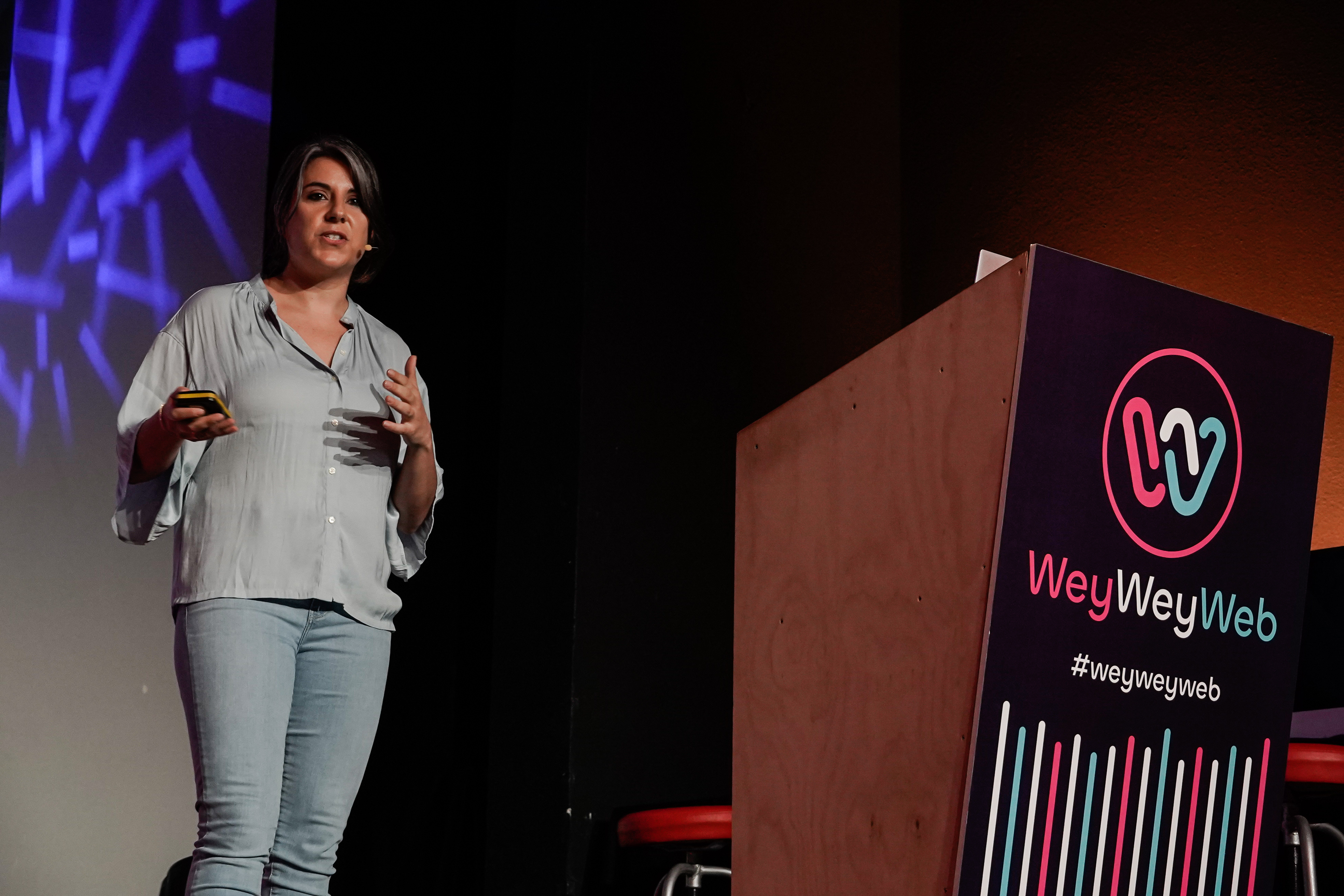
Wey Wey Web
WeyWeyWeb is a community and conference focused on web development and design. I've participated as a content curator, MC and speaker, sharing insights on interaction design and multimodal interfaces.
The community brings together professionals passionate about creating better web experiences and pushing the boundaries of what's possible on the web platform.
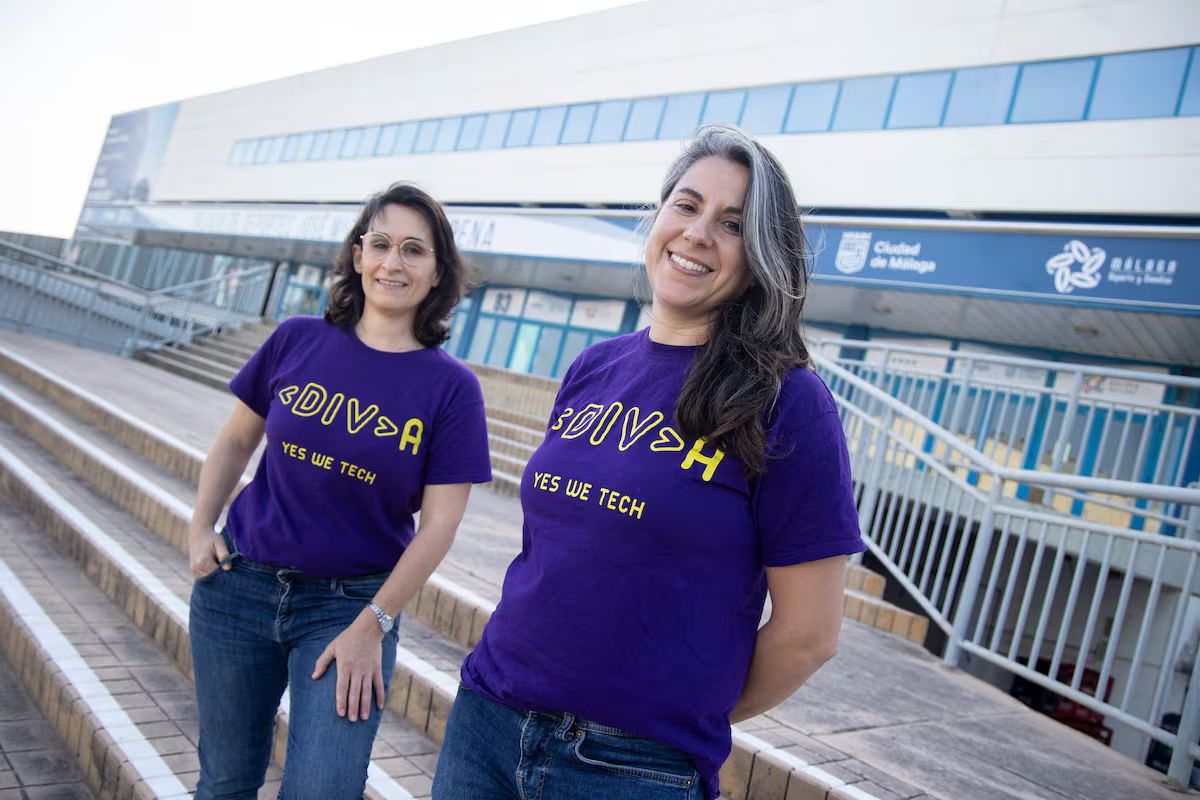
Yes We Tech
Yes We Tech is an NGO dedicated to promoting diversity and inclusion in technology. I co-founded the community in 2015, since then I'm involved in mentoring and supporting underrepresented groups entering the tech industry.
Through workshops, talks, and mentorship, we work to create a more inclusive tech ecosystem where everyone has the opportunity to thrive.
en.la.interfaz
en.la.interfaz is a Spanish-language knowledge centre about design, technology, and the intersection between humans and digital interfaces.
I contribute by discussing design principles, sharing case resources, and exploring how we can create more thoughtful and effective digital products for Spanish-speaking audiences.
Contact
I'm looking for Lead, Principal, or Director-level design roles — where I can shape product strategy, build design teams, and tackle complex problems.
I work best when:
- The problem is complex, with competing constraints and no obvious solution — I'm good at connecting ideas across a mess like that
- You need someone who can think at both strategic and tactical levels
- Technical feasibility is a major consideration
- Cross-functional collaboration is critical
- You're building something that needs to scale, at a pace where you can actually see the value land for customers
I'm probably not the right fit if you need:
- Small, disconnected UI tweaks to satisfy one client at a time, with no throughline between them
- Pure visual design or branding work (I can do it, but specialists are better)
- Deep specialization in one narrow area
This page is about the work. It isn't all of me — the rest matters just as much, even if it's not written here.
Contact MeLast update: September, 2026